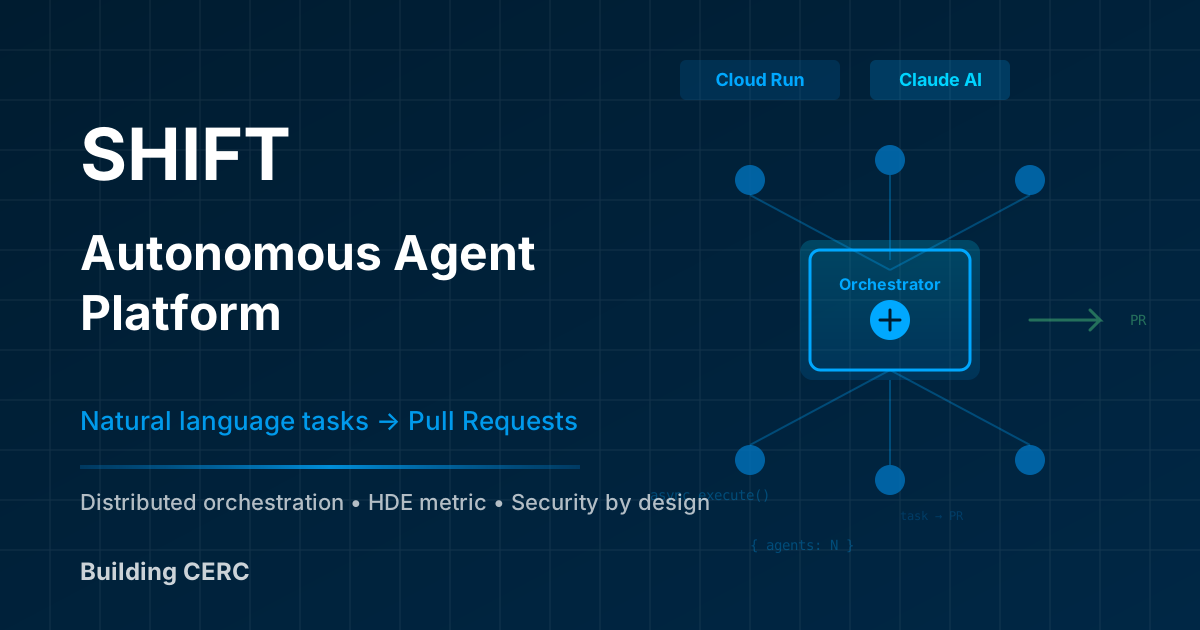
SHIFT: CERC's Autonomous Agent Platform
TL;DR
- SHIFT is CERC's platform that orchestrates autonomous AI agents for coding tasks
- Agents receive tasks in natural language and deliver pull requests, code reviews, and documentation
- Runs on Google Cloud Run with Claude (Anthropic) models via Vertex AI
- We created the HDE (Human Developer Equivalent) metric: measures AI cost in equivalent developer minutes
- Multiple squads are already using it and agent PRs are in production
AI-assisted coding has become table stakes. Smart autocomplete, editor-integrated chat, snippet generation — all of this is available to any engineering team. But there is a fundamental difference between assisting a developer and executing a task autonomously.
At CERC, we decided not to wait for an off-the-shelf solution. We built our own autonomous coding agent platform. We call it SHIFT.
Why “SHIFT”?
The name is not accidental. SHIFT carries the concept of shift-left — the practice of moving development stages earlier in the lifecycle, bringing quality, testing, and analysis to the beginning of the process. But at CERC, we took this concept further.
For an autonomous agent to execute a task with quality, the engineer describing it must exercise fundamental skills: analytical thinking, problem decomposition, and structured problem solving. The task description must be clear, precise, and with well-defined intent — otherwise, the agent will not produce a good result.
The SHIFT Mindset
Decomposition
Break complex problems into executable parts
Clarity of intent
Describe what needs to be done with precision
Analytical thinking
Analyze context, dependencies, and impact
This mindset shift is one of the pillars of CERC’s AI strategy. We are not adopting AI merely as an assistant — we are integrating autonomous agents into our engineering DNA. Every engineer who learns to describe tasks for SHIFT is, in practice, becoming a better engineer: more analytical, more structured, more precise in technical communication.
AI at CERC is not a side tool. It is part of how we build software.
What is SHIFT?
SHIFT is an orchestration platform that delegates coding tasks to autonomous AI agents. But SHIFT is not just a tool triggered by humans — it integrates into CERC’s engineering ecosystem as an active participant.
Tasks can be triggered from multiple sources:
- Web interface — engineers create tasks by describing intent in natural language
- Events — webhooks and integrations react to ecosystem events (e.g., new PR opened, alert triggered)
- Schedules — recurring tasks run at programmed times (e.g., dependency audit every Monday)
- Pipelines — CI/CD stages invoke agents as part of the delivery flow
Regardless of the origin: the Orchestrator receives the intent, selects the appropriate agent, provisions an isolated environment, and delivers the result — a pull request, a code review, or updated documentation.
The platform runs on Google Cloud Run and uses Claude by Anthropic models via Vertex AI as the reasoning engine for its agents.
Architecture
Orchestrator
Central control point. Receives tasks from any source (UI, events, schedules, pipelines), selects the agent type, configures model and tools, and launches the job in the runtime.
Agent Runtime
Ephemeral and distributed containers — one per task, N in parallel. Run entirely in the cloud: no developer machine resources are consumed, no approvals or local permissions required. The agent clones the repo, creates a branch, runs Claude, and produces the artifact.
Agent Broker
Real-time state broker. Collects events from all agents via event sourcing and distributes them over WebSocket. Enables observing each agent at any moment.
Dashboard
Monitoring interface, analytics, and consumption control. Includes The Office — a pixel-art visualization of agents in real time — and detailed per-task metrics.
Purpose-Built Agents: the Shifties
SHIFT’s agents are not generic. Each one has a specific purpose, a configured model, a set of tools, and a defined output mode. Internally, we call this concept the agent’s “soul” — what defines who it is and how it operates.
Implement features, fix bugs, and execute refactoring — delivering pull requests ready for review.
Analyze existing pull requests and leave comments with improvement suggestions, patterns, and potential issues.
Produce or update technical documentation from code, keeping docs and code in sync.
Model flexibility is intentional. Not every task needs the most expensive or most capable model. SHIFT allows choosing the right model for each task type, optimizing the balance between cost and quality.
The Office — Real-Time Agent Monitoring
When you have multiple autonomous agents working simultaneously, observability is not a luxury — it is a necessity. You need to see what they are doing.
SHIFT includes a real-time monitoring dashboard called The Office. The concept is an isometric pixel-art office where each agent appears as an animated sprite sitting at a virtual desk.

Beyond the visualization, there is a real-time event feed showing the progress of each task. It is like having a digital factory floor where you can monitor the entire operation at a glance.
For autonomous systems, the ability to monitor and intervene is as important as the ability to execute.
HDE — Human Developer Equivalent
One of the most common questions about AI agents is: “How much time does this save?”
The problem is that estimating the duration of a development task is inherently subjective. Two engineers will give different estimates for the same task. The “time saved” metric ends up being based on a guess compared to an actual value.
SHIFT approaches this differently. Instead of estimating the task, we measure the cost.
The Formula
HDE = AI Cost / Dev Hourly Rate
Result in equivalent developer minutes
Practical Example
| AI token cost | $2.50 |
| Avg developer hourly rate | $25.00 |
| HDE | = 6 minutes |
The task cost the equivalent of 6 minutes of a human developer.
Objectivity
Token cost is concrete data, not an estimate
Reproducibility
Same calculation for any task
No Bias
Eliminates human over/underestimation
Configurable
Each team sets their own hourly rate
HDE flips the question. Instead of “how long would this take?”, we ask “how much did this cost relative to a human?”. It is a simple, objective, and comparable metric.
Security by Design
Granting autonomy to AI agents on production code repositories demands a rigorous security posture. SHIFT was designed with this premise from the start.
Each agent runs in an ephemeral, isolated container — no access to the internal network, no persistent credentials, no write permissions beyond the designated repository. When the task ends, the container is destroyed. There is no residual state, no remaining attack surface.
Beyond isolation, the platform underwent dedicated security testing before going to production: attack surface analysis, access control validation, permission reviews on repository and pipeline integrations, and prompt injection tests on the agents themselves. SHIFT’s security is not a layer added after the fact — it is part of the architecture.
For the developer, this means a frictionless experience: nothing needs to be installed locally, no special approvals or permissions are required to use the platform, and the engineer’s machine remains completely untouched. The agent works in the cloud, delivers the result, and disappears.
Production Reality
Use cases already in operation:
Feature implementation across multiple repositories
Automated code reviews on pull requests
Documentation generation and updates
Bug investigation and fixes
Cross-repository refactoring tasks
The road ahead involves intensifying usage, expanding the agent catalog, and integrating SHIFT into CERC’s broader AI ecosystem.
What SHIFT Represents
SHIFT is the materialization of CERC’s commitment to engineering innovation. We did not build agents to replace developers — we built them to amplify developers.
Autonomous agents free engineers to focus on the most complex and creative problems, while well-defined tasks are executed reliably, traceably, and with measurable cost.
In future posts, we will share specific use cases, lessons learned, and technical details of how SHIFT has evolved since its first version.
This post was written by: Allan Martins | COE - Architecture.